AI Content Quality Control: Building Quality Gates That Catch What Humans Miss

AI content quality control is the systematic process of evaluating, scoring, and filtering machine-generated text before it reaches your audience. It matters because LLMs produce content at a speed no human team can manually review — and the errors they make (hallucinations, tone drift, factual inaccuracies) are often subtle enough to slip past tired eyes. The solution isn’t hiring more reviewers. It’s building automated quality gates that function as checkpoints across your entire content pipeline, catching what humans miss while letting good content flow.
If you’re publishing AI-generated content at any meaningful volume without a structured QA system, you’re gambling with your brand’s credibility every single day.
Why Traditional Content QA Breaks Down at Scale
Manual review worked when a team of writers produced a handful of articles per week. An editor could read every piece, flag issues, and send things back for revision. That model collapses the moment you introduce generative AI into your content workflow.
The problem isn’t that human reviewers are bad at their jobs. It’s that the job changed underneath them.
The Volume Problem: Human Reviewers Versus Machine-Speed Output
A single LLM can generate a polished 1,500-word article in under 60 seconds. A skilled human editor needs 15–30 minutes to properly review that same article for accuracy, tone, brand alignment, and factual claims. Do the math: if your AI pipeline produces 200 pieces of content per day, you’d need a team of 25–50 full-time editors just to keep pace — assuming zero breaks, zero meetings, and zero context-switching.
That math doesn’t work for anyone.
What actually happens in practice is predictable. Organizations start by reviewing everything, fall behind within weeks, then shift to spot-checking a random sample. The pieces that don’t get reviewed? They go live with whatever the model produced. And LLMs fail in specific, repeatable ways:
- Hallucinations — the model confidently states something that’s factually wrong, often with invented citations
- Tone drift — output gradually shifts away from brand voice, especially across long-form or multi-prompt workflows
- Outdated information — models trained on older data present stale facts as current
- Subtle inaccuracies — numbers that are close but not right, dates off by a year, names slightly wrong
According to a 2024 study by the Tow Center for Digital Journalism at Columbia University, AI-generated news content contained verifiable factual errors in roughly 40% of articles examined. That’s not a rounding error. That’s a systemic risk.
Hidden Costs of Letting Unreviewed AI Content Go Live
The business case for AI content QA infrastructure isn’t abstract. The costs of skipping it are concrete and compounding:
Reputational damage. A single hallucinated statistic cited by a customer, journalist, or regulator can undo years of trust-building. Once your brand is associated with unreliable information, the stain spreads.
SEO penalties. Google’s helpful content guidelines explicitly target low-quality, unhelpful pages. A flood of unchecked AI content that’s thin, inaccurate, or duplicative can tank your domain authority.
Legal exposure. Publishing false health claims, fabricated legal precedents, or incorrect financial data creates real liability — especially in regulated industries.
Brand dilution. When every piece of content sounds slightly different because nobody’s enforcing voice consistency, your brand becomes noise.
The investment in quality gates isn’t a cost center. It’s insurance.
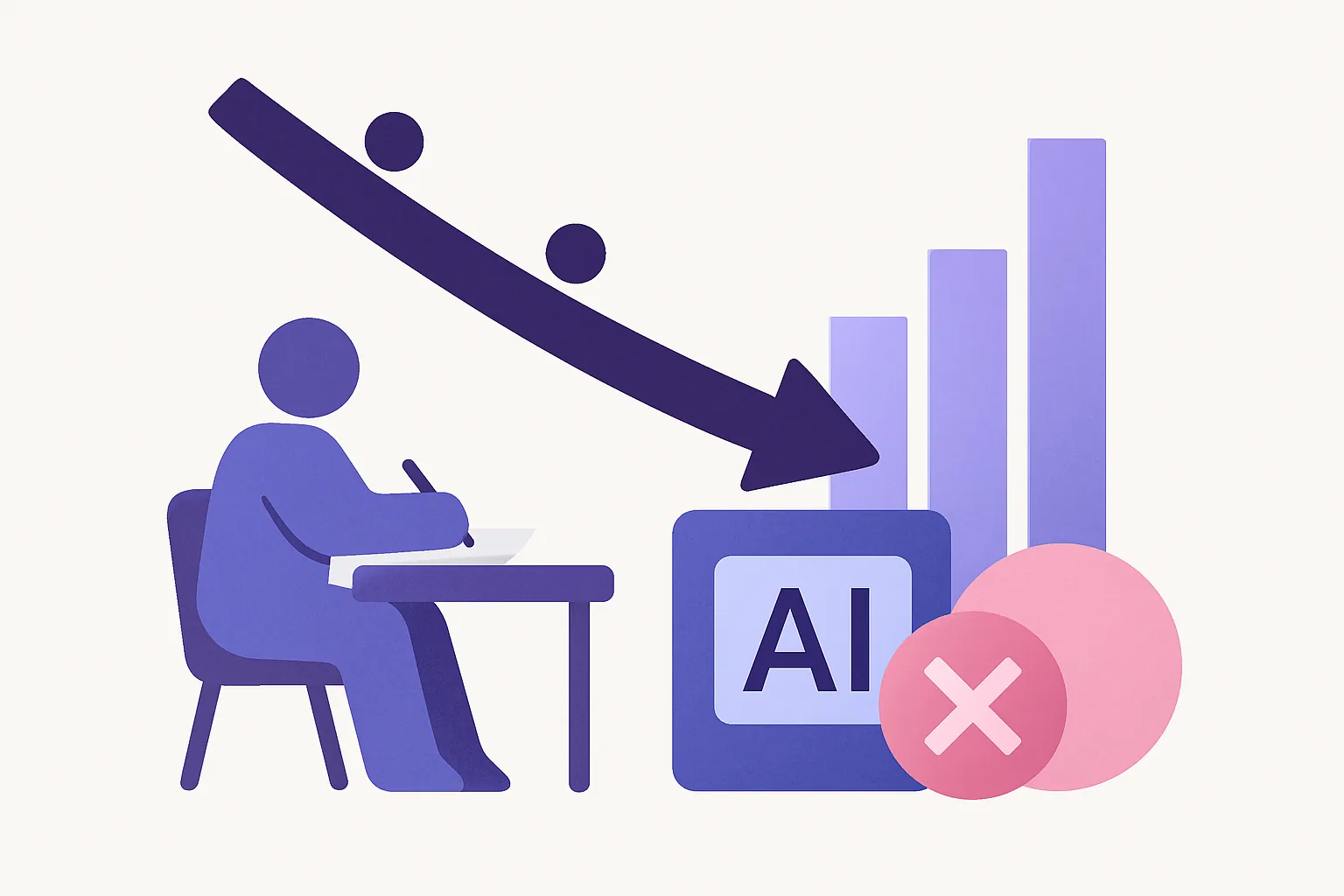
Anatomy of an Effective AI Content Quality Control Pipeline
Think of content guardrails not as a single checkpoint but as a layered defense system. The best pipelines catch different types of errors at different stages, so nothing relies on a single point of failure.
Three layers matter: what happens before generation, what happens immediately after, and what happens once content is live.
Pre-Generation Content Guardrails and Prompt Engineering
The cheapest error to fix is the one that never happens. Pre-generation guardrails shape LLM behavior before a single word of output is produced.
Structured system instructions are your first line of defense. Instead of relying on vague prompts like “write a blog post about X,” effective guardrails specify:
- Exact tone and voice parameters (“Write in second person, conversational but authoritative, at an 8th-grade reading level”)
- Explicit constraints (“Do not invent statistics. Do not cite sources unless provided in the context window.”)
- Output format requirements (“Use H2 and H3 headers. Include a bulleted list of key takeaways.”)
- Topic boundaries (“Stay within the scope of [topic]. Do not discuss [adjacent but off-limits topics].”)
Input validation catches problems even earlier. Before a prompt reaches the model, automated checks can verify that required context documents are attached, that the topic falls within approved categories, and that the request doesn’t conflict with brand guidelines.
Few-shot examples embedded in system prompts dramatically reduce tone drift. Showing the model three examples of approved content in your brand voice is more effective than any amount of descriptive instruction.
These aren’t suggestions — they’re engineering decisions that measurably reduce downstream error rates. Teams that invest in prompt architecture typically see 30–50% fewer quality issues in raw output compared to teams using ad hoc prompts.
Real-Time LLM Output Evaluation Checkpoints
Even the best prompts don’t eliminate all errors. The second layer applies automated evaluation to every piece of generated content before it moves forward.
Effective LLM output evaluation combines multiple checks:
| Check Type | What It Catches | Common Tools/Approaches |
|---|---|---|
| Factual consistency scoring | Hallucinations, contradictions with source material | Retrieval-augmented verification, NLI models |
| Readability analysis | Off-target complexity, overly dense prose | Flesch-Kincaid scoring, custom readability thresholds |
| Tone/voice alignment | Brand voice drift, inappropriate register | Embedding similarity against approved samples |
| Originality detection | Plagiarism, excessive overlap with training data | Semantic similarity search against published content |
| Compliance screening | Prohibited claims, missing disclaimers | Rule-based keyword detection plus classifier models |
| Structural validation | Missing sections, incorrect formatting | Template matching, schema validation |
The key principle: no single check is sufficient. A piece can score perfectly on readability while being riddled with hallucinations. Layering matters.
One practical approach gaining traction is using a second LLM as a judge — feeding the generated content along with source materials into a separate model tasked specifically with identifying errors. This “LLM-as-judge” pattern works surprisingly well for catching logical inconsistencies and unsupported claims, though it introduces its own failure modes (which we’ll cover in the FAQ section below).
Automated scoring should produce a composite quality score for each piece of content. Pieces above the threshold pass through. Pieces below it get flagged for human review or regeneration. Pieces in the middle — the gray zone — are where your human-in-the-loop process earns its keep.
Post-Publication Monitoring and Feedback Loops
Quality control doesn’t end at publish. The third layer tracks content performance after it’s live and feeds findings back into the system.
Engagement signals reveal quality issues that automated checks miss. A page with high bounce rates, low time-on-page, or unusual exit patterns may contain errors that readers catch even when machines don’t.
Error reporting workflows give readers and internal teams a frictionless way to flag problems. A simple “Report an issue” mechanism on every page, routed to a triage queue, catches errors that would otherwise persist indefinitely.
Periodic content audits — monthly or quarterly — sample published content and re-evaluate it against current quality standards. This is especially important after LLM model updates, which can change output characteristics in subtle ways.
The most valuable part of post-publication monitoring is the feedback loop. Every error caught after publication should trigger two questions: Why didn’t our pre-publication checks catch this? and How do we update our guardrails to prevent it next time? This creates a continuously improving system — the quality gates get smarter with every cycle.
For more on building effective content workflows, explore the Contentify AI Blog where we regularly cover evolving best practices.

Practical Framework: Setting Up Your First Quality Gate System
Theory is useful. Implementation is what actually protects your brand. Here’s how to build a working system, starting from wherever you are today.
Defining Quality Criteria and Scoring Rubrics
You can’t measure what you haven’t defined. Before building any automated checks, establish your quality dimensions and how you’ll score them.
A practical starting rubric:
| Quality Dimension | Weight | Score 1 (Fail) | Score 3 (Acceptable) | Score 5 (Excellent) |
|---|---|---|---|---|
| Factual accuracy | 30% | Contains verifiable errors | Accurate but lacks specificity | Precise, well-sourced claims |
| Brand voice alignment | 20% | Off-brand tone or register | Mostly consistent | Indistinguishable from human-written brand content |
| Relevance | 20% | Misses the topic or audience | Addresses topic adequately | Deeply relevant, anticipates reader questions |
| Readability | 15% | Wrong reading level, poor flow | Acceptable structure and clarity | Engaging, well-paced, scannable |
| Originality | 10% | Heavily derivative or duplicative | Adequate perspective | Fresh angle, unique value |
| Compliance | 5% | Contains prohibited claims | Meets minimum requirements | Proactively includes required disclosures |
Adjust weights based on your industry. A healthcare publisher might weight factual accuracy at 50% and originality at 5%. A lifestyle brand might flip those priorities.
The rubric isn’t just for machines — it calibrates your human reviewers too. Everyone evaluating content should score the same piece within a narrow range. If they don’t, your rubric needs refinement.
Choosing Between Automated, Human-in-the-Loop, and Hybrid Review
Not all content carries the same risk, and not all content deserves the same level of scrutiny.
Fully automated review works for high-volume, low-risk content: product descriptions, metadata, internal documentation, social media variations. The quality gates score it, pass or fail it, and humans only see the failures.
Human-in-the-loop review is essential for high-risk content: anything medical, financial, or legal; thought leadership pieces; content that will be widely distributed or permanently published. A human reviewer sees every piece, but automated scoring pre-filters and highlights likely problem areas so the reviewer’s attention goes where it matters most.
Hybrid models handle the middle ground. Automated checks process everything. Content above a high confidence threshold publishes automatically. Content below a low threshold gets rejected or regenerated. Everything in between goes to a human queue, prioritized by risk score.
The hybrid approach is where most organizations should start. It respects the reality that you don’t have unlimited human review capacity while ensuring that the highest-risk content always gets human eyes.
If you’re just getting started with AI-powered content operations, our Welcome guide walks through the fundamentals.
Five Common Pitfalls When Implementing Content Guardrails
Building quality gates is straightforward in concept and surprisingly easy to get wrong in practice. These are the mistakes I see most often:
-
Over-filtering that kills creativity. If your guardrails are so tight that 60% of generated content gets rejected, you haven’t built a quality system — you’ve built a bottleneck. Effective guardrails have rejection rates between 10–25% for well-prompted content.
-
Under-specifying quality criteria. “The content should be good” isn’t a quality criterion. If you can’t explain to a new team member exactly what score a piece of content should receive and why, your rubric isn’t specific enough.
-
Ignoring edge cases. Quality gates tuned for typical content will miss atypical failures. Adversarial testing — deliberately feeding your pipeline content designed to break it — reveals blind spots before your audience does.
-
Skipping calibration. Your automated scoring and your human reviewers should agree most of the time. If they diverge, one of them is wrong. Regular calibration sessions (monthly at minimum) keep the system honest.
-
Failing to update rules as LLM behavior evolves. Model updates change output characteristics. A guardrail that worked perfectly with one model version may miss new failure modes in the next. Tie your quality gate review cadence to your model update schedule — every time you update or switch models, re-validate your checks.
Frequently Asked Questions About AI Content QA
What Is AI Content Quality Control and Why Does It Matter?
AI content quality control is the practice of systematically evaluating machine-generated text for accuracy, relevance, brand alignment, and compliance before and after publication. It matters because generative AI produces content faster than humans can review it, and LLM errors — hallucinations, tone inconsistencies, factual mistakes — are often subtle enough to evade casual review. Any organization publishing AI-generated content at scale needs structured QA to protect its reputation, SEO standing, and legal position.
How Do You Detect Hallucinations in LLM Output?
The most reliable approach combines multiple methods:
- Retrieval-augmented verification — cross-referencing claims against trusted source documents provided in the prompt context
- NLI (Natural Language Inference) models — checking whether generated claims are entailed by, contradicted by, or neutral to source material
- Confidence scoring — some models can estimate their own certainty, though this is unreliable as a sole signal
- Chain-of-thought validation — asking the model to show its reasoning, then checking whether the reasoning supports the conclusion
No single method catches everything. The Stanford HAI research group has documented that even state-of-the-art detection methods miss 15–30% of hallucinations, which is why layered approaches outperform any individual technique.
Can AI Effectively Review Its Own Content?
Partially. The “LLM-as-judge” pattern — using one model to evaluate another’s output — catches many errors, especially logical inconsistencies and unsupported claims. Research from UC Berkeley’s LMSYS shows that strong LLM judges agree with human evaluators roughly 80% of the time on quality assessments.
The limitation: models share similar blind spots. An LLM reviewing another LLM’s output may accept the same hallucination both models would generate. That’s why single-model self-review is insufficient. Effective systems use a different model as judge, combine LLM evaluation with rule-based checks, and maintain a human review layer for high-stakes content.
What Are Content Guardrails and How Do They Differ From Filters?
Guardrails are proactive — they shape the model’s output before or during generation. System instructions, structured prompts, and few-shot examples are all guardrails. They steer the model toward desired behavior.
Filters are reactive — they evaluate output after generation and block or flag content that violates rules. Toxicity classifiers, keyword blocklists, and compliance scanners are filters.
Both are necessary. Guardrails reduce the frequency of problems. Filters catch what guardrails miss. A system with only guardrails will still produce some bad content. A system with only filters wastes compute generating content it then throws away.
How Often Should Quality Gate Rules Be Updated?
At minimum, review your quality gate rules:
- After every LLM model update (new model versions change output behavior)
- Monthly, based on error patterns from post-publication monitoring
- Quarterly, aligned with brand guideline reviews
- Immediately, when a significant error reaches publication
Treat quality gates as living systems. A rule set that hasn’t been updated in six months is almost certainly missing new failure modes.
What Metrics Best Measure AI Content Quality Over Time?
Track these KPIs to gauge your system’s effectiveness:
- Pass-through rate — percentage of content that clears all quality gates without human intervention (target: 70–85%)
- Human override frequency — how often human reviewers disagree with automated scores (should decrease over time)
- Post-publication error rate — errors found after content goes live (target: below 2%)
- Mean time to detection — how quickly errors are identified once published
- Reader engagement metrics — bounce rate, time on page, and scroll depth as proxies for content quality
- Error category trends — which types of errors are increasing or decreasing over time
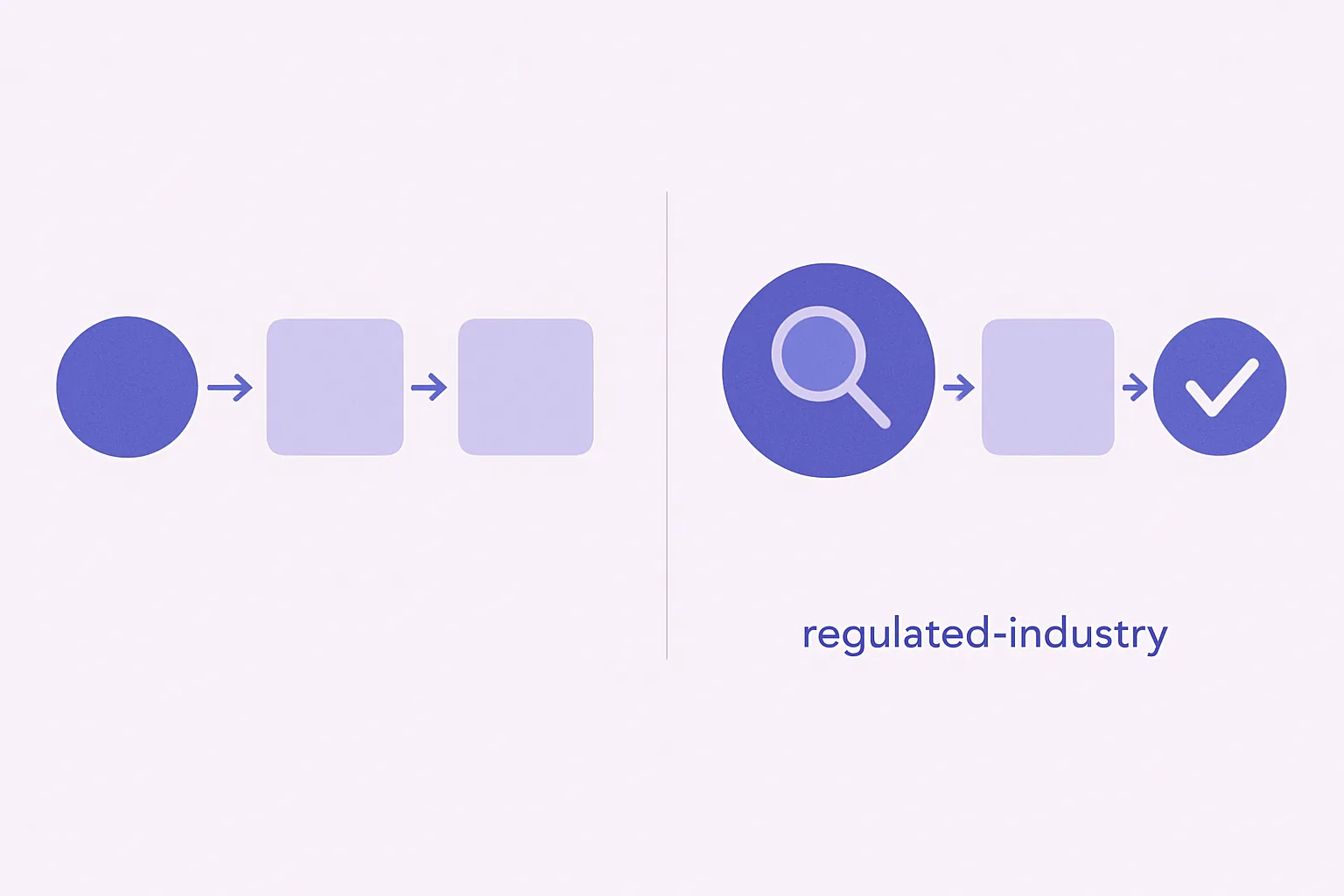
Is LLM Output Evaluation Different for Regulated Industries?
Yes, substantially. Healthcare, finance, and legal content require additional layers:
- Mandatory human review for all published content, regardless of automated scores
- Audit trails documenting who reviewed what, when, and what changes were made
- Regulatory-specific compliance checks (FDA guidelines for health claims, SEC requirements for financial disclosures, bar association rules for legal content)
- Version control with the ability to trace any published claim back to its source
In regulated industries, automated quality gates serve as a first pass that makes human review faster and more focused — they never replace it entirely.
Moving From Reactive Fixes to Proactive Quality Architecture
Most teams discover they need AI content quality control the hard way — after a hallucination embarrasses them, after a Google ranking drops, after a customer screenshots something wrong. That’s the reactive path.
The proactive path is designing quality into your content pipeline from day one. Not as an afterthought bolted onto the end. Not as a manual review step that becomes a bottleneck. As architecture — automated, layered, continuously improving.
Start where you are. If you’re publishing AI content today with no quality gates, implement one: a basic factual consistency check against source documents. That single checkpoint will catch more errors than you expect. Then add a second layer. Then a third. Each one compounds.
The organizations that will win with AI content aren’t the ones generating the most. They’re the ones generating the most trustworthy content — and trust is a function of quality control.
Build the gates. Let them learn. Your future self will thank you.
References:
- Tow Center for Digital Journalism, Columbia University — Research on AI-generated news accuracy: towcenter.columbia.edu
- Google Search Central — Helpful content guidelines: developers.google.com
- Stanford HAI — Hallucination detection research: hai.stanford.edu
- UC Berkeley LMSYS — LLM-as-judge evaluation studies: lmsys.org