Answer Engine Optimization: How to Format Content for Direct AI Responses
Answer engine optimization (AEO) is the practice of structuring and formatting content so AI-powered answer engines — like ChatGPT, Perplexity, and Google AI Overviews — can extract, understand, and cite it as a direct response to user queries. Unlike traditional SEO, which focuses on ranking in a list of blue links, AEO targets the answer layer: the single synthesized response an AI delivers before a user ever clicks through to a website.
This matters right now because the way people find information is fracturing. According to Gartner, traditional search volume will drop 25% by 2026 as AI chatbots and virtual agents absorb queries that used to flow through Google. Zero-click answers already account for roughly 60% of Google searches, and AI Overviews are accelerating that trend. Content that isn’t formatted for LLMs risks becoming invisible — not because it lacks quality, but because machines can’t efficiently parse it.
AEO isn’t replacing SEO. It’s an evolution. The foundations remain the same: expertise, authority, trustworthiness, and topical depth. But the tactical layer shifts. You’re no longer just writing for humans who scan and click. You’re writing for machines that extract and synthesize. That demands a different approach to structure, format, and information density.
How AI Answer Engines Select and Surface Content
Understanding how AI engines choose what to cite changes how you write.
Most modern AI answer systems use some form of retrieval-augmented generation (RAG). The process works in two stages. First, the system retrieves relevant documents from an indexed corpus — web pages, knowledge bases, structured databases. Then, the language model generates a response using those retrieved documents as grounding material. Your content needs to survive both stages: it must be retrievable and extractable.
During retrieval, authority signals matter. Domain reputation, backlink profiles, topical consistency, and freshness all influence which documents make the shortlist. This is where traditional SEO equity pays dividends. A well-established site with deep topical coverage gets retrieved more often.
During generation, the LLM evaluates something different: conciseness, structure, and factual density. The model is looking for passages it can confidently paraphrase or quote. Content that buries its key claims under three paragraphs of preamble gets skipped. Content that opens with a clear, factual statement gets cited.
AI engines also weigh entity clarity. If your content references “AEO” without defining it, the model has less confidence in the passage. If you define the term, connect it to related concepts, and use consistent naming throughout, the model can map your content to its internal knowledge graph with higher certainty.
AEO vs. SEO: Where They Overlap and Diverge
The two disciplines share DNA but diverge in execution.
| Dimension | Traditional SEO | Answer Engine Optimization |
|---|---|---|
| Primary goal | Rank in search results | Be cited as the answer |
| Success metric | Position, CTR, traffic | Citation frequency, brand mentions |
| Content structure | Optimized for scanning | Optimized for extraction |
| Keywords | Query-matched terms | Entity-aligned concepts |
| Authority signals | E-E-A-T, backlinks, domain age | Same, plus factual density and source reliability |
| Schema markup | Helpful for rich snippets | Critical for entity disambiguation |
| Content format | Long-form, keyword-rich | Answer-first, hierarchically structured |
The overlap is real. E-E-A-T matters everywhere. Topical authority matters everywhere. Backlinks still signal trust to both Google’s traditional algorithm and the retrieval systems feeding AI engines. But the aeo content format prioritizes different things at the page level: direct answer blocks, clean heading hierarchies, and explicit entity definitions.
Think of it this way: SEO gets you into the library. AEO gets you quoted in the lecture.
The AEO Content Format: Structuring Pages That AI Engines Prefer
This is the tactical core. The specific structural patterns that increase your chances of being selected by AI answer engines come down to four elements.
Lead With a Direct Answer Block
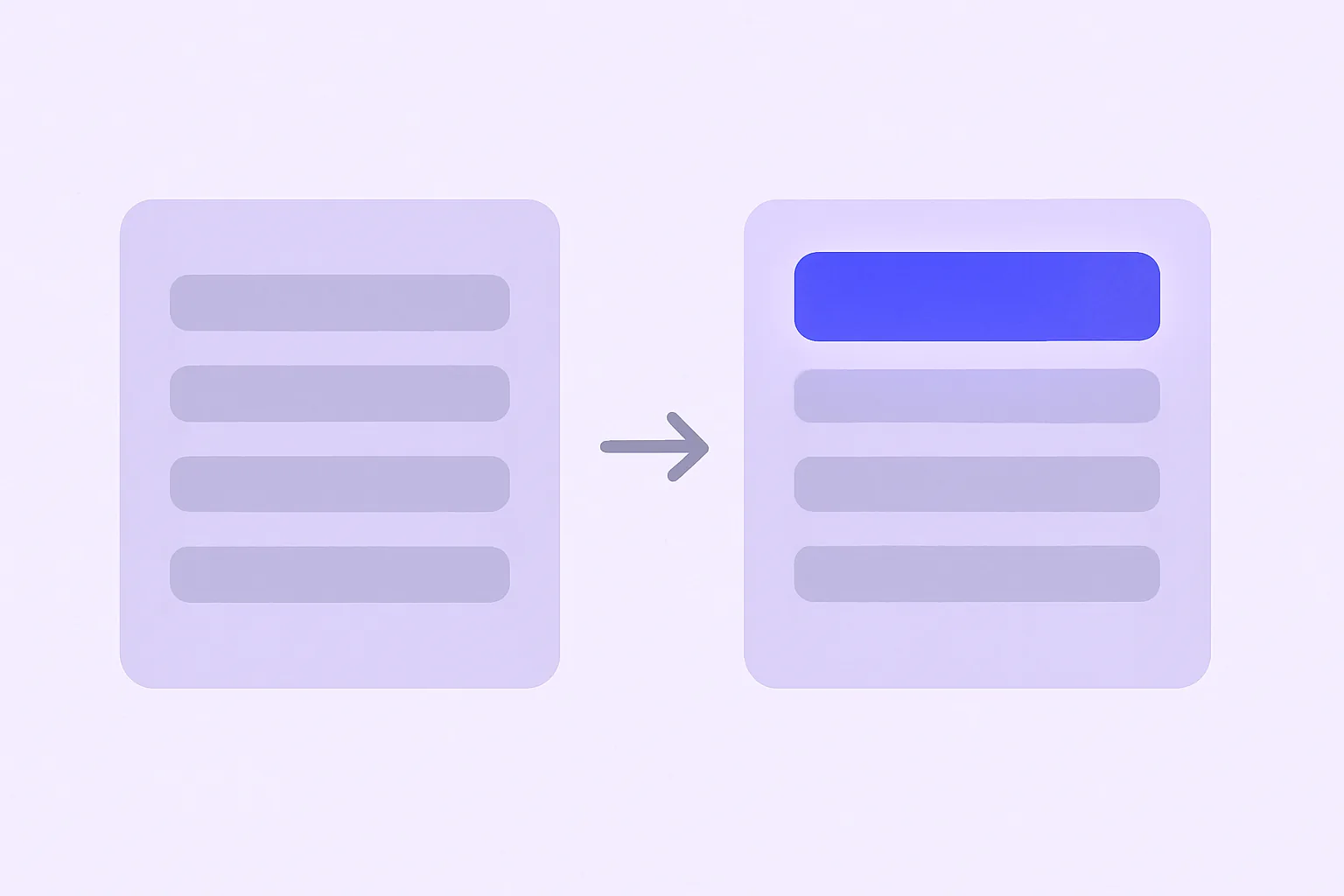
Every section of your content should open with a concise, self-contained answer — 40 to 60 words that directly address the heading’s implied question. This is the inverted pyramid adapted for AI: answer first, expand second.
Here’s what this looks like in practice.
Before (traditional approach):
“In today’s rapidly evolving digital landscape, many marketers are beginning to wonder about the best ways to structure their content. With the rise of AI tools and changing consumer behaviors, it’s more important than ever to consider how your content strategy aligns with emerging trends…”
After (answer-first approach):
“The most effective AEO content format places a direct, concise answer within the first two sentences of each section. AI engines extract passages that immediately address a query without requiring the model to parse through introductory context. Start with the answer, then provide supporting detail.”
The difference is stark. The first version forces an LLM to wade through filler to find the actual information. The second version hands it a citable passage on a platter.
This doesn’t mean every section reads like a dictionary entry. After the answer block, expand with examples, data, nuance, and context. The answer block is the hook for machines. The expansion is for humans. Both matter.
Use Hierarchical Headings and Semantic HTML
AI parsers rely on heading hierarchy to understand how ideas relate to each other. A page with proper H1 → H2 → H3 nesting tells an LLM: “This subtopic belongs to that parent topic, which belongs to the overall theme.”
Three rules that matter most:
- One H1 per page, matching the primary topic.
- Descriptive H2s and H3s that mirror natural-language queries. “What Is Answer Engine Optimization” beats “Introduction.” “How to Audit Content for LLM Readability” beats “Step One.”
- No skipped levels. Don’t jump from H2 to H4. The hierarchy is semantic, not decorative.
Clean HTML structure also helps. Extraneous <div> nesting, inline styles, and non-semantic elements add noise that makes extraction harder. Keep the markup lean. If you’re working with a CMS, audit the output HTML — many themes inject unnecessary wrapper elements that dilute structural clarity.
Embed Structured Data and Entity Markup
Schema markup acts as a machine-readable label for your content. It tells AI engines what type of content lives on the page, what entities it discusses, and how those entities relate to each other.
The highest-impact schema types for ai answer optimization:
- FAQPage schema — marks up question-and-answer pairs for direct extraction
- HowTo schema — structures step-by-step processes with clear inputs and outputs
- Speakable markup — identifies sections suitable for voice-assistant readout
- About and Mentions — connects your content to recognized entities (people, organizations, concepts)
Schema isn’t mandatory for AI citation. But it significantly reduces ambiguity. When an LLM’s retrieval system encounters a page with FAQ schema, it knows with certainty which text is a question and which is the answer. Without schema, it has to infer — and inference introduces error.
You can validate your structured data using Google’s Rich Results Test to ensure your markup is correctly implemented before deployment.
Write for Entities, Not Just Keywords
Traditional keyword optimization targets search terms. Entity-based optimization targets concepts.
An entity is a distinct, well-defined thing: a person, a place, an organization, a concept. “Answer engine optimization” is an entity. “AI Overviews” is an entity. When you write content for LLMs, you need to define these entities clearly, use consistent naming, and connect them to related entities in ways that mirror how knowledge graphs work.
Practical steps:
- Define key terms explicitly the first time they appear. Don’t assume the reader (or the model) knows what RAG stands for.
- Use consistent naming. If you call it “answer engine optimization” in one section, don’t switch to “AEO search strategy” in the next without establishing the equivalence.
- Link related concepts. When you mention E-E-A-T, briefly explain what it is and how it connects to your main topic. This creates a semantic web within your content that LLMs can traverse.
- Reference authoritative entities. Mentioning Google, specific schema types, or established frameworks gives the model additional anchor points for contextual understanding.

Practical AI Answer Optimization Strategies You Can Apply Today
Theory without implementation is decoration. Here’s what to actually do.
Audit Existing Content for LLM Readability
Before creating new content, fix what you already have. Run through this checklist for your highest-traffic pages:
- Does each major section open with a direct, extractable answer (40–60 words)?
- Are headings descriptive and question-based where appropriate?
- Is there filler text before the first substantive claim in each section?
- Does the page define its key terms explicitly?
- Is structured data implemented and validated?
- Does the content use consistent entity naming throughout?
- Can you paste a section into an AI chatbot and get a coherent, accurate summary back?
That last point is a practical litmus test. Paste your content into an AI tool and ask it to summarize. If the summary misses your key points, the structure isn’t guiding extraction effectively.
This kind of audit pairs well with a broader content strategy review. If you’re welcome to the idea of rethinking how your content performs across AI platforms, starting with an audit gives you a baseline.
Create Content That Answers Follow-Up Questions
AI engines don’t just answer one question. They anticipate the next one. Content that maps out question chains — the logical sequence of queries a user follows — signals comprehensive coverage.
Start with your primary question. Then ask: what would someone ask next?
For “What is answer engine optimization?”, the follow-up chain might look like:
- How does AEO differ from SEO?
- What content format works best for AI engines?
- How do I implement structured data for AEO?
- How do I measure whether my content is being cited?
Each of these becomes a section or subsection. The depth of your answers matters more than the total word count. A focused 1,500-word article that thoroughly answers five related questions outperforms a 4,000-word piece that vaguely touches twenty.
Google’s “People Also Ask” boxes and the conversational threads in AI chatbots are both excellent sources for mapping these question chains. Use them as research tools, not just inspiration.
Build Topical Authority Across a Content Cluster
A single page rarely earns consistent AI citations on its own. LLMs assess source reliability partly based on whether a domain demonstrates deep, consistent expertise on a topic.
This is where content clusters come in. A cluster consists of:
- One pillar page covering the broad topic comprehensively (like this article on answer engine optimization)
- Multiple supporting pages that go deep on subtopics (structured data implementation, entity optimization, AI citation tracking)
- Internal links connecting them in a logical hierarchy
The interlinks matter. They create a navigable semantic structure that both AI retrieval systems and traditional crawlers can follow. When an LLM’s retrieval system finds three interlinked pages from the same domain all discussing ai answer optimization from different angles, it assigns higher confidence to that source.
Plan your cluster around the questions your audience actually asks. Map those questions to individual pages. Link them together. Update them regularly. This is how you build the kind of topical authority that makes AI engines treat your domain as a reliable source. Protecting user data throughout this process matters too — transparent privacy practices contribute to the trust signals that both users and AI systems evaluate.
Monitor Your Visibility in AI-Generated Answers
You can’t optimize what you can’t measure. Tracking AI citations is still an emerging discipline, but several approaches work today:
Manual monitoring. Regularly query AI platforms with questions your content should answer. Note whether your brand or content is cited, paraphrased, or absent. Track this in a spreadsheet over time.
Brand mention tracking. Tools that monitor brand mentions across the web can catch references in AI-generated content that gets published or shared.
Referral traffic analysis. Check your analytics for traffic from AI platform domains. Perplexity, ChatGPT with browsing, and other AI tools that link to sources will show up as referral sources.
Content iteration. When you find that a competing passage is being cited instead of yours, study its structure. Is it more concise? Better defined? More recently updated? Use those insights to refine your own content.
The measurement landscape will mature rapidly. For now, consistent manual testing combined with referral traffic analysis gives you a workable feedback loop.

Frequently Asked Questions About Answer Engine Optimization
Is AEO Replacing Traditional SEO?
No. AEO complements SEO. Traditional search still drives the majority of web traffic, and organic rankings remain critical for most businesses. AEO ensures your content stays visible as AI-powered search grows alongside conventional results.
What Types of Content Perform Best in AI Answer Engines?
Definitional content, how-to guides, comparison explanations, and factual reference material earn the most AI citations. Content that is concise, well-structured, and demonstrably authoritative gets selected over vague or poorly organized alternatives.
How Long Does It Take to See Results From AEO?
It varies by domain authority and content quality. Restructuring existing high-authority content can produce visible changes in AI citations within weeks. Building topical authority from scratch typically takes three to six months of consistent publishing.
Does Content Length Matter for AI Answer Optimization?
Length itself is not a factor. Information density and structure determine extraction likelihood. A focused 1,200-word article with clear answer blocks can outperform a 5,000-word piece that buries its key points in filler.
Can Small Websites Compete in AI Answer Results?
Yes. AI engines prioritize answer quality and specificity over raw domain size. Niche sites with deep expertise on focused topics regularly earn citations over larger, more general competitors — especially on specialized queries.
What Role Does Schema Markup Play in AEO?
Schema helps AI engines understand content structure, entity relationships, and content type. It’s not mandatory for citation, but it significantly increases the likelihood that your content gets accurately extracted and attributed.
Should I Optimize for Specific AI Platforms or All of Them?
Focus on universal best practices: clear structure, direct answers, authority signals, and entity clarity. These fundamentals work across all major AI answer engines. Platform-specific tricks tend to be fragile and short-lived.
Start Optimizing for the Answer Layer of Search
The shift toward AI-mediated answers is accelerating, and the compounding advantage goes to early movers. Every month you wait, competitors are restructuring their content, implementing schema, and building the topical authority that makes AI engines trust their domains.
Three actions will generate the highest impact:
- Restructure your content with answer-first formatting. Open every section with a direct, extractable answer block. Cut the preamble.
- Implement structured data. FAQ schema, HowTo schema, and entity markup reduce ambiguity and increase extraction accuracy.
- Build topical authority through content clusters. Single pages don’t win sustained AI citations. Interlinked clusters of deep, focused content do.
Answer engine optimization is rapidly moving from competitive advantage to baseline expectation. The question isn’t whether to start — it’s whether you’ve already fallen behind.