Winning Google AI Overview: Schema + Content Structure That Works
Google AI Overview is Google’s generative AI feature that synthesizes answers from multiple web sources directly in search results, replacing the need for users to click through to individual pages. If you want your content cited in these AI-generated summaries, you need a deliberate combination of structured content, proper schema markup, and topical depth. This isn’t traditional SEO with a fresh coat of paint — it’s a fundamental shift in how search engines consume and redistribute your content.
The old game was about earning a blue link. The new game is about being the source an AI trusts enough to quote.
What Is Google AI Overview and Why It Changes SEO
Google launched AI Overviews (formerly part of the Search Generative Experience, or SGE) to provide synthesized, multi-source answers at the top of search results. Instead of pulling a single snippet from one page, Google’s generative model reads across dozens of pages, extracts relevant information, and assembles a cohesive answer — with source attribution links alongside.
This changes the economics of organic search. According to Search Engine Land’s analysis, AI overviews appear on roughly 30-40% of informational queries as of early 2025, and that number keeps climbing. When an AI overview appears, traditional position-one results get pushed below the fold. CTR for standard organic listings drops. But here’s the nuance: pages cited within the AI overview often see higher-quality traffic, because users who click through have already been primed with context and are looking for deeper engagement.
The shift from link-based SERPs to generative answers means your content needs to serve two audiences simultaneously: human readers and AI parsers. Optimizing for one without the other leaves value on the table.
How AI Overviews Select and Synthesize Sources
Google’s generative AI doesn’t just grab the top-ranking page and paraphrase it. The system evaluates multiple sources, cross-references claims, and synthesizes a blended answer. Source selection leans heavily on E-E-A-T signals — experience, expertise, authoritativeness, and trustworthiness.
Pages that demonstrate first-hand experience (original data, case studies, practitioner insights) get prioritized over generic aggregation. The AI also favors content that’s clearly structured, because structured content is easier to parse programmatically. A well-organized page with semantic headings, defined entities, and front-loaded answers gives the AI exactly what it needs to extract a reliable excerpt.
Topical authority matters too. Sites that cover a subject comprehensively across multiple interlinked pages signal deeper expertise than a single standalone article. This is where your content strategy becomes a competitive weapon — not individual pages in isolation, but the ecosystem of content surrounding a topic.
Key Differences Between Featured AI Snippets and Traditional Results
Don’t confuse AI overviews with featured snippets. They look different, behave differently, and require different optimization approaches.
| Feature | Traditional Featured Snippet | Google AI Overview |
|---|---|---|
| Source count | Single page | Multiple pages synthesized |
| Content origin | Direct extraction from one URL | AI-generated summary citing several URLs |
| Position | Top of SERP (position zero) | Above all organic results, often expandable |
| Optimization approach | Target one specific query with a concise answer | Provide comprehensive, well-structured topical coverage |
| Attribution | Single link | Multiple source links in sidebar or inline |
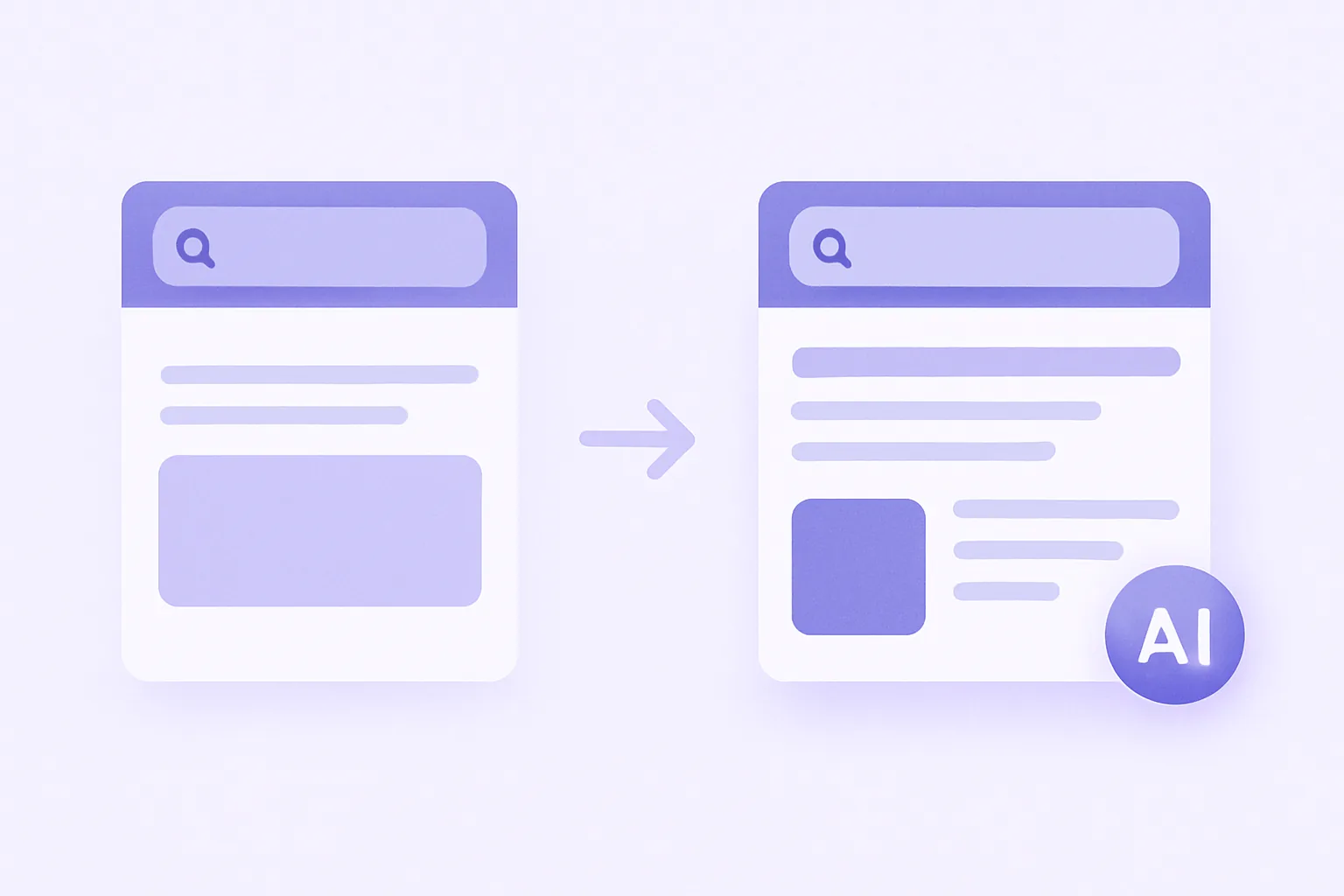
Featured snippets reward precision — one clean answer to one specific question. AI overviews reward depth and authority across a topic. A page optimized purely for position-zero featured snippets might be too narrow to earn an AI overview citation. You need breadth and precision.
Knowledge panels and People Also Ask boxes still operate on their own logic. AI overviews sit above all of them, making ai overview seo a distinct discipline that layers on top of existing optimization rather than replacing it.
Content Structure Patterns That Earn AI Overview Citations
Structure isn’t decoration. It’s the mechanism by which AI parses your content. Pages that earn featured ai snippets share consistent structural patterns — and they’re patterns you can replicate.
Front-Loading Concise Answers With Supporting Depth
Every H2 and H3 on your page should begin with a direct, factual answer in the first 40-60 words. Then expand with context, evidence, examples, and nuance.
This is the inverted pyramid adapted for generative search. The AI scans your heading, reads the opening sentences beneath it, and decides whether that block contains a reliable, extractable answer. If your opening paragraph under a heading is throat-clearing or background context, the AI moves on to a competitor’s page that gets to the point faster.
Here’s what this looks like in practice:
Weak opening:
“Many people wonder about the best way to structure content for modern search engines. Over the years, SEO has evolved significantly, and today’s approaches differ from what worked in 2015…”
Strong opening:
“Structure content for AI overviews by leading each section with a 1-2 sentence direct answer, then expanding with supporting evidence and examples. This mirrors how Google’s generative AI extracts summary content from source pages.”
The strong version gives the AI a clean, extractable statement. The supporting depth that follows builds trust and keeps human readers engaged. Both audiences get what they need.
Using Heading Hierarchy to Signal Topical Authority
Proper heading nesting — H2 for major topics, H3 for subtopics, H4 for granular details — creates a machine-readable outline of your page’s content architecture. Google’s AI uses this hierarchy to understand relationships between concepts.
A few rules that matter:
- One H1 per page (your title). Everything else flows beneath it.
- H2 headings should be semantically descriptive, not clever. “How Schema Markup Supports AI Visibility” beats “The Secret Sauce.”
- H3 headings should nest logically under their parent H2. If your H3 doesn’t relate directly to the H2 above it, your structure is broken.
- Cover subtopics comprehensively. Thin sections with only a sentence or two under a heading signal shallow coverage. Aim for at least 100-150 words per section.
The heading hierarchy is your content’s skeleton. A clear skeleton makes it easy for AI to extract the right bone.
Lists, Tables, and Definitions That AI Prefers to Extract
AI overviews love structured formats. Lists, tables, and explicit definitions appear disproportionately in AI overview citations compared to plain prose paragraphs.
When to use ordered lists: Step-by-step processes, ranked items, sequential instructions. Numbered lists signal a specific order that AI can reproduce accurately.
When to use unordered lists: Feature comparisons, non-sequential characteristics, grouped attributes. Bullet points work when order doesn’t matter.
When to use tables: Side-by-side comparisons, specification breakdowns, multi-variable data. Tables are particularly powerful for comparison queries (“X vs Y” searches).
When to use inline definitions: Introduce a term, then define it in the same sentence or the sentence immediately following. Example: “Speakable schema is a structured data type that identifies sections of a page best suited for audio playback, such as voice assistant responses.”
These formats aren’t just visually scannable for humans — they’re programmatically extractable for AI. A page mixing prose, lists, tables, and definitions across its sections gives Google’s AI multiple entry points for citation.

Schema Markup Strategies for AI Overview SEO
Schema markup won’t single-handedly get you into an AI overview. But it acts as a clarity and trust signal, helping Google’s systems understand exactly what your content covers, how authoritative it is, and which sections answer which questions. Think of schema as metadata that removes ambiguity — and AI systems hate ambiguity.
Essential Schema Types: FAQPage, HowTo, and Article
Three schema types carry the most weight for sge optimization:
Article schema is foundational. It tells Google your content is a structured article with a defined author, publication date, and publisher. Every page targeting AI overview inclusion should have Article schema at minimum. Key properties: headline, author (with Person or Organization type), datePublished, dateModified, and image.
FAQPage schema marks up question-and-answer pairs on your page. This is particularly effective for pages targeting informational queries, because the Q&A format directly mirrors how AI overviews structure their responses. Each question-answer pair becomes a discrete, extractable unit.
HowTo schema applies to instructional content with defined steps. If your page walks through a process — “how to audit your site for AI overview readiness,” for example — HowTo schema maps each step, its order, and any required tools or materials. Google’s AI can extract individual steps or the complete sequence.
The key is matching schema type to content intent. Don’t slap FAQPage schema on a page that isn’t actually structured as Q&A. Mismatched schema erodes trust with Google’s systems. For a deeper understanding of how structured data relates to content policies, review the Terms governing content usage.
Implementing Speakable and ClaimReview for Enhanced Visibility
Two advanced schema types deserve attention for forward-looking ai overview seo:
Speakable schema identifies sections of your page that are most suitable for text-to-speech playback. While currently supported primarily for news content in English, Speakable signals to Google which parts of your content are concise, self-contained, and suitable for audio or AI extraction. As voice search and AI assistants converge with traditional search, Speakable becomes increasingly relevant.
To implement Speakable, use CSS selectors or XPath expressions pointing to specific content blocks — typically your front-loaded answer paragraphs. Each Speakable section should be 2-3 sentences maximum, factually complete, and understandable without surrounding context.
ClaimReview schema marks up fact-checked claims on your page. If your content evaluates or verifies specific claims, ClaimReview signals to Google that your page has been through a verification process. This directly supports E-E-A-T signals and can boost your authority for queries where factual accuracy is critical.
Both schema types have limited current adoption, which means early implementers gain a structural advantage as Google expands AI overview coverage.
Validating and Testing Structured Data for SGE Readiness
Implementing schema is only half the job. Invalid or incomplete schema gets ignored entirely.
- Run every page through Google’s Rich Results Test (search.google.com/test/rich-results). This tool shows exactly which schema types Google detects and flags errors or warnings.
- Check Search Console’s Enhancement Reports for structured data errors. Navigate to Enhancements > [Schema Type] to see page-level error details.
- Validate JSON-LD syntax using a JSON validator before deploying. A single missing comma or unclosed bracket silently breaks your entire schema block.
- Audit for completeness. Google recommends including all “recommended” properties, not just required ones. A FAQPage schema with only
nameandacceptedAnswerworks, but addingdateCreatedandauthorstrengthens the signal. - Test across page types. Schema that works on your blog template might break on your landing page template due to different HTML structures.
Common mistakes that prevent schema from being processed:
- Nesting schema types incorrectly (e.g., putting HowTo inside FAQPage)
- Using schema for content that doesn’t visibly appear on the page (a policy violation)
- Duplicate schema blocks from conflicting plugins or manual implementations
- Missing required properties that cause the entire block to be ignored
Practical Optimization Checklist With Real Examples
Theory matters, but execution is what gets you cited. Here’s how to turn the principles above into a repeatable workflow.
Step-by-Step Page Audit for AI Overview Readiness
Run this audit on your top 10 organic traffic pages first — they have the most to gain (or lose).
- Check current AI overview presence. Search your target query in an incognito browser. Does an AI overview appear? Are you cited? Are competitors?
- Evaluate heading structure. Open your page source or use a browser extension to view the heading hierarchy. Is it logical? Are H2/H3/H4 tags nested properly?
- Assess answer front-loading. Read the first two sentences under each heading. Do they contain a direct, extractable answer? Or do they build up slowly?
- Review content formatting. Count your lists, tables, and definitions. If you have 2,000 words of unbroken prose, you’re leaving structured extraction opportunities on the table.
- Audit existing schema. Run the Rich Results Test. Note which schema types are present, which have errors, and which are missing entirely.
- Analyze competitor AI overview appearances. For queries where competitors are cited, study their page structure. What formatting patterns do they use? What schema types do they implement?
- Identify content gaps. Does your page cover all the subtopics that appear in the AI overview? Missing subtopics mean missed citation opportunities.
- Check freshness signals. Is your
dateModifiedschema current? Has the content been updated within the last 6 months? Stale content loses AI overview citations to fresher alternatives.

Before and After: Restructuring Content for Generative Search
Consider a hypothetical how-to article on “setting up email authentication.”
Before optimization:
- 1,800 words of continuous prose with two H2 headings
- No schema markup
- Opening paragraph spent 150 words on the history of email authentication
- No lists, tables, or definitions
- No FAQ section
After optimization:
- Same core content reorganized under 4 H2s and 8 H3s
- Article + HowTo + FAQPage schema implemented
- Each section opens with a 1-2 sentence direct answer
- Step-by-step process converted to a numbered list
- Comparison table added for SPF vs. DKIM vs. DMARC
- Inline definitions added for technical terms
- FAQ section added with 5 common questions
Measurable outcomes (over 90 days):
- Page appeared in AI overviews for 3 target queries (previously zero)
- Organic click-through rate increased 18% despite AI overview presence
- Average time on page increased 24%, suggesting higher-quality traffic
- Page earned featured snippets for 2 additional long-tail queries
The content itself didn’t change dramatically. The structure changed everything.
Frequently Asked Questions About Google AI Overview Optimization
How Do I Know If My Page Appears in an AI Overview?
The most reliable method is searching your target queries manually in an incognito browser window. Google Search Console doesn’t yet provide a dedicated filter for AI overview appearances in performance reports. Several third-party rank tracking tools have added AI overview tracking features, so check whether your current SEO toolset includes this capability.
Does Schema Markup Guarantee Inclusion in AI Overviews?
No. Schema markup is a supporting signal that improves machine readability and can increase the likelihood of citation. Content quality, topical authority, and E-E-A-T signals remain the primary factors Google’s AI evaluates when selecting sources. Think of schema as removing friction — it makes it easier for Google to understand and trust your content, but it doesn’t override weak content.
What Types of Queries Trigger AI Overviews Most Often?
Informational queries (“what is,” “how does”), how-to queries (“how to set up,” “steps to”), comparison queries (“X vs Y”), and multi-faceted questions that require synthesized answers trigger AI overviews most frequently. Transactional queries (“buy,” “price”) and navigational queries (“login,” “homepage”) trigger them far less often. Google continues expanding query coverage, so this landscape shifts regularly.
Can Small Websites Compete for Featured AI Snippets?
Yes. Niche authority can outweigh raw domain size. Small sites that provide unique data, original research, first-hand practitioner experience, or deep coverage of underserved subtopics regularly earn AI overview citations over larger competitors. Focus on topics where you have genuine expertise, implement thorough schema, and structure content for extraction. The AI doesn’t care about your domain authority score — it cares about whether your content reliably answers the query.
How Often Does Google Update Which Sources Appear in AI Overviews?
Source selection is dynamic and can change daily. Google re-evaluates sources based on content freshness, relevance updates, new competing pages, and changes to the query’s intent landscape. A page cited in an AI overview today might lose that citation next week if a competitor publishes fresher, better-structured content. Ongoing content maintenance — updating facts, refreshing dates, expanding coverage — is essential for sustained visibility.
Should I Optimize Differently for AI Overviews Than for Traditional SEO?
Most AI overview optimization reinforces good traditional SEO practices. The key differentiators are the additional emphasis on structured answers (front-loading concise responses), schema markup implementation, and comprehensive topical coverage across subtopics. If you’re already doing solid SEO — clear headings, quality content, proper technical foundations — you’re 70% of the way there. The remaining 30% is structural optimization specifically for AI extraction.
Will AI Overviews Reduce Organic Traffic to My Website?
Some zero-click behavior will increase as AI overviews answer simple queries directly. That’s real, and pretending otherwise doesn’t help. But pages cited as sources within AI overviews often receive more qualified traffic — visitors who click through have already read the summary and want deeper information. Being the cited source is the new competitive advantage. The traffic you lose to zero-click was often low-intent anyway; the traffic you gain from citation tends to convert better.
Next Steps: Building an AI-First Content Strategy
Start with your top 10 pages by organic traffic. Run the audit checklist above on each one. Prioritize pages that already rank in the top 10 for queries where AI overviews appear — these are your lowest-hanging fruit.
Implement schema incrementally. Add Article schema to every page this week. Add FAQPage schema to pages with Q&A content next week. Layer in HowTo schema for instructional content after that. Validate each implementation before moving to the next.
Monitor results over 60-90 day cycles. AI overview appearances fluctuate, so don’t panic over daily changes. Look for trends: are more of your pages earning citations over time? Is your organic CTR holding steady or improving despite AI overview presence?
Build this into your ongoing content workflow. Every new piece of content should be structured for AI extraction from the start — front-loaded answers, semantic headings, appropriate schema, and comprehensive subtopic coverage. Retrofitting is necessary for existing content, but prevention beats cure.
The sites winning google ai overview citations right now aren’t doing anything magical. They’re being deliberate about structure, thorough about schema, and disciplined about content quality. That’s a playbook anyone can follow.
References: