Content Optimization vs Creation: A Decision Framework for SEO Content Teams

The Quick Answer: Should You Optimize or Create?
When debating content optimization vs creation, here’s the short version: optimize when an existing page already carries authority, backlinks, or ranking history. Create when no page on your site covers the topic or when search intent demands a format you don’t have. Most SEO content teams need both strategies running simultaneously — the real problem is that they lack a system to decide which lever to pull for each keyword opportunity.
That missing system is what this framework solves. By the end of this piece, you’ll have a repeatable decision process you can embed into your content planning cycle — one that stops you from guessing and starts turning your content prioritization into a competitive advantage.
Why the Optimize-vs-Create Decision Matters for Scalable SEO
Getting this decision wrong is expensive, and the costs compound quietly. Publish a new page when you should have refreshed an existing one, and you risk cannibalizing your own rankings. Two pages fighting for the same query split your authority, confuse Google’s crawlers, and dilute the internal link equity you’ve built. On the flip side, pour resources into optimizing a page that never had real potential, and you’ve burned cycles that could have captured a net-new keyword cluster.
A scalable SEO workflow depends on making this call correctly — not once, but hundreds of times across your content roadmap. Content prioritization isn’t a nice-to-have; it’s the mechanism that separates teams shipping 50 pages a quarter with flat traffic from teams shipping 20 pages with compounding organic growth.
The Hidden Cost of Always Publishing New Pages
The “publish more” instinct feels productive. More pages, more keywords, more chances to rank. But unchecked creation leads to content bloat: thin pages competing with each other, crawl budget wasted on low-value URLs, and an internal linking structure so diluted that no single page gets enough equity to rank well.
A 2022 study by Ahrefs found that 96.55% of pages get zero traffic from Google. Many of those pages exist because someone created a new article instead of strengthening what already existed. Every unnecessary page you add makes it harder for search engines to identify your best content on a given topic.
The Risk of Only Refreshing Existing Content
The opposite extreme is equally dangerous. Teams that only refresh existing content develop blind spots. New search intents emerge. Competitors publish comprehensive guides on topics you haven’t touched. Your content footprint stagnates while the market moves.
If your site has no page covering a rising keyword cluster, no amount of tweaking your existing articles will capture that traffic. You need net-new content to fill genuine topical gaps — and you need to spot those gaps systematically, not accidentally.
How To Run an SEO Content Audit That Informs Your Next Move
Before you can decide whether to optimize or create, you need a clear picture of what you already have and how it’s performing. An SEO content audit gives you that picture. It’s not a one-time project; it’s a diagnostic tool you’ll return to regularly.
Here’s the process, broken into three steps.
Categorize Pages by Performance Tier
Pull your full URL inventory from your CMS, then layer in performance data from your analytics platform and search console. Sort every page into one of four buckets:
| Performance Tier | Signals | Recommended Action |
|---|---|---|
| High-performing | Top 1-4 rankings, strong traffic, good engagement | Protect — monitor, don’t overhaul |
| Declining | Was ranking well, traffic dropping over 3-6 months | Refresh existing content — update, expand, re-optimize |
| Underperforming | Low traffic, ranking 20+, thin content | Improve substantially or consolidate into a stronger page |
| Missing | No existing URL targets a validated keyword cluster | Create new content |
The declining tier is where most quick wins live. These pages proved they can rank — they just need attention.
Map Search Intent Against Your Current Inventory
Take your target keyword list and group keywords by intent clusters — informational, transactional, navigational, commercial investigation. Then map each cluster to an existing URL.
Where you find a cluster with no corresponding URL, that’s a creation opportunity. Where you find a URL that partially covers the intent but misses key subtopics or answers the wrong question, that’s an optimization opportunity.
This mapping exercise also reveals cannibalization risks: multiple URLs targeting the same intent cluster. Flag those for consolidation.
Evaluate Authority Signals on Existing Pages
Not all underperforming pages are hopeless. Before you decide to scrap one, check its authority signals:
- Backlink profile — How many referring domains point to this page? Quality matters more than quantity.
- Internal links — Is this page well-connected within your site architecture?
- Page age — Older pages that once ranked carry historical trust signals.
- Peak ranking position — A page that once hit position 3 has proven relevance. Something changed; figure out what.
A page with 15 quality backlinks and a history of ranking in the top 10 is almost always worth optimizing rather than replacing. You’d need months (or years) to build that same authority on a brand-new URL.
A Practical Decision Framework for Content Prioritization
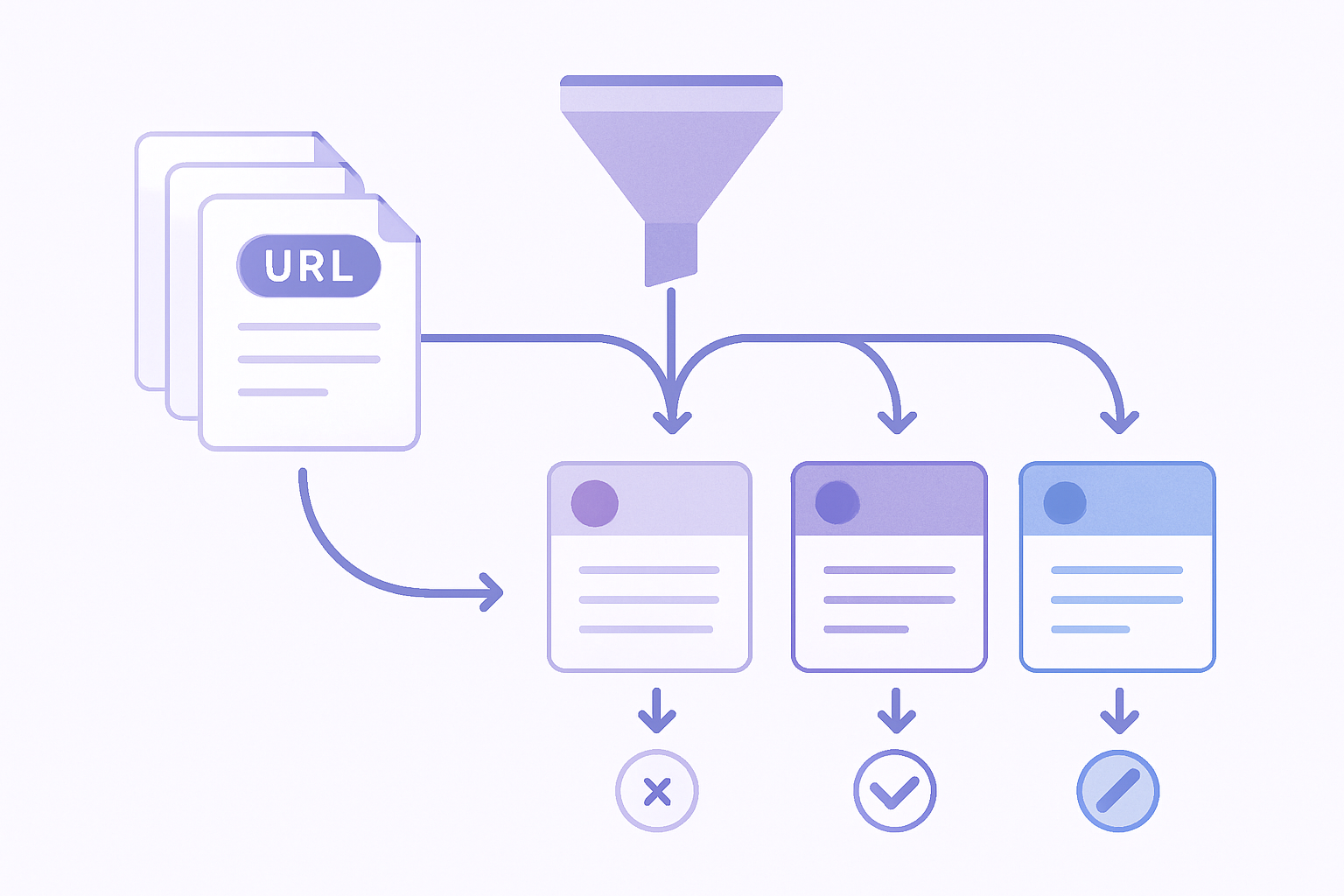
With your audit data in hand, you need a repeatable framework to make the optimize-or-create call for every opportunity on your roadmap. Here’s a decision matrix built around five criteria:
- Does an existing URL rank (positions 1-50) for the target cluster? If no → create.
- Does the existing page match the dominant search intent? If no → create a new page with the right format and intent match.
- Does the page have meaningful authority signals (backlinks, age, internal links)? If yes → optimize.
- How large is the content quality gap between your page and the top 3 results? Small gap → refresh. Massive gap with mismatched format → consider creating.
- What’s the business value of this keyword cluster? High value + existing asset = optimize aggressively. High value + no asset = prioritize creation.
When To Refresh Existing Content
Refresh when:
- Your page ranks positions 5-20 and the content is outdated but structurally sound
- The page has backlinks you’d lose by creating a new URL
- Search intent hasn’t fundamentally shifted — users still want the same type of content
- Competitors have simply gone deeper or more current than you
Tactical refresh steps:
- Update statistics, examples, and screenshots with current data
- Expand thin sections where competitors provide more depth
- Improve the title tag and meta description for click-through rate
- Add internal links to and from related content — if you’re running a programmatic SEO playbook, these internal links become even more critical at scale
- Refresh the publish date only after making substantive changes (not just fixing a typo)
When To Create a Brand-New Page
Create when:
- No existing page on your site targets the keyword cluster
- Search intent has fundamentally changed — what was a listicle query now demands an interactive tool or a long-form guide
- The topic requires a completely different content format (comparison page vs. how-to guide vs. landing page)
- You’re entering a new topical area where you have zero coverage
Creation is also the right call when you’ve identified a subtopic that deserves its own dedicated page rather than a section buried in a broader article. A 300-word section inside a pillar page won’t outrank a competitor’s 2,000-word dedicated guide.
When To Consolidate or Retire Pages
This is the third option teams consistently overlook. If your audit reveals three blog posts all targeting “email marketing best practices” with none of them ranking well, you don’t need to optimize all three or create a fourth. You need to merge them.
Pick the URL with the strongest authority signals. Combine the best content from all three into that single page. Set up 301 redirects from the retired URLs. The consolidated page inherits the combined link equity and eliminates the cannibalization problem.
Retire pages outright (with redirects to the nearest relevant URL) when the content is irrelevant, the topic no longer aligns with your business, or the page has zero authority signals and zero traffic.

Building a Scalable Workflow That Balances Both Strategies
A framework only works if it’s embedded in your operations. Here’s how to make the optimize-or-create decision systematic rather than something you debate in a meeting every time a new keyword opportunity surfaces.
Set a Recurring Audit Cadence
For sites publishing 10+ pages per month, run a lightweight audit monthly. Focus on pages showing traffic declines greater than 20% month-over-month and newly published pages that haven’t gained traction after 90 days.
For smaller sites, a quarterly audit is sufficient. Define triggers that prompt an out-of-cycle review:
- A core algorithm update drops traffic by 15%+
- A competitor launches a content hub in your primary topic area
- Your business enters a new product category or market
Allocate Resources Across Optimization and Creation
Ratio-based planning gives your team clarity. The right split depends on site maturity:
| Site Maturity | Suggested Split | Rationale |
|---|---|---|
| New site (< 1 year) | 80% creation / 20% optimization | Build topical coverage first |
| Growing site (1-3 years) | 60% creation / 40% optimization | Fill gaps while refreshing early content |
| Mature site (3+ years) | 40% creation / 60% optimization | Most keyword clusters are covered; optimize for dominance |
These aren’t rigid rules. Adjust quarterly based on your audit findings. If your audit reveals 30 declining pages and only 5 genuine content gaps, shift the ratio toward optimization that quarter. Your privacy policy and legal pages aside, every content URL should earn its place on your site.
Track the Right Metrics To Validate Decisions
You need separate tracking for optimized pages and newly created pages. Blending them into one report hides whether your framework is actually working.
For refreshed pages, track:
- Organic traffic change (30/60/90 days post-refresh vs. the 90 days prior)
- Ranking position movement for target keywords
- Click-through rate changes
For new pages, track:
- Time to first page-one ranking
- Organic traffic at 90 and 180 days
- Conversion rate compared to your site average
Over time, this data refines your framework. You’ll learn which types of refreshes move the needle most and which content gaps deliver the highest ROI when filled with new pages.
Frequently Asked Questions About Content Optimization vs Creation
Is It Better To Update Old Blog Posts or Write New Ones?
It depends on what the old post brings to the table. If it has backlinks from quality domains, a history of ranking in the top 20, and content that’s structurally sound but outdated, updating it is almost always more efficient than starting from scratch. You preserve accumulated authority. If the old post has zero backlinks, zero traffic, and targets an intent you’ve since covered better elsewhere, retire it and create something new only if there’s a genuine gap.
How Often Should You Refresh Existing Content?
Evergreen content should get a substantive review at least annually. Pages covering time-sensitive topics — statistics roundups, regulatory guides, trend pieces — need refreshes every 3-6 months. Any page showing a traffic decline of 20%+ over two consecutive months should trigger an immediate review regardless of schedule.
What Is an SEO Content Audit and How Do You Start One?
An SEO content audit is a systematic review of every content URL on your site, evaluated against performance data and search intent alignment. Start with three steps: (1) export your full URL inventory from your CMS or sitemap, (2) pull organic traffic, impressions, average position, and click-through rate data for each URL, (3) categorize every URL by the action it needs — protect, refresh, consolidate, or flag as a gap for new content.
Can Optimizing Existing Content Hurt Rankings?
Yes. Three common mistakes cause ranking drops during optimization: changing the page’s target intent (rewriting a “what is X” guide into a “how to buy X” page), removing sections that matched queries driving traffic, and altering the URL without implementing proper 301 redirects. Safeguard against these by documenting the page’s current ranking keywords before editing, preserving content that aligns with those queries, and never changing URLs unless absolutely necessary.
How Do You Prioritize Which Content To Work on First?
Use an impact-vs-effort matrix. Plot each opportunity by estimated traffic or revenue impact (vertical axis) against the effort required (horizontal axis). High-authority pages with small content gaps — a missing section, outdated stats, a weak title tag — sit in the high-impact, low-effort quadrant. Start there. These are your fastest wins.
Should New Websites Focus Entirely on Content Creation?
Mostly, yes. In the first 6-12 months, your primary job is building topical coverage and establishing authority. But even new sites should audit after that initial period. Some early pages will underperform because you wrote them before you fully understood your audience’s search behavior. Catch those early and either improve them or consolidate before the content bloat compounds.
What Tools Help With Content Optimization Decisions?
Look for three categories of tools: (1) an analytics platform that lets you segment organic traffic by URL and track changes over time, (2) a rank tracker that monitors position history and keyword cannibalization, and (3) a content scoring or analysis tool that compares your page’s depth and structure against top-ranking competitors. The specific tool matters less than whether it gives you URL-level performance data you can act on.
Next Step: Apply the Framework to Your Content Roadmap
Start small. Pull performance data for your top 20 pages by organic traffic. Run them through the decision criteria above. You’ll likely find 3-5 pages that need a refresh, 1-2 that should be consolidated, and a handful of keyword gaps that demand new content.
Do this once and you’ll recover traffic you’ve been quietly losing. Do it quarterly and you’ll build the kind of compounding organic growth that separates good SEO teams from great ones. The advantage isn’t in choosing optimization over creation or vice versa — it’s in knowing exactly which to do, for which page, right now.